Selfhood, agency, and the story of a life
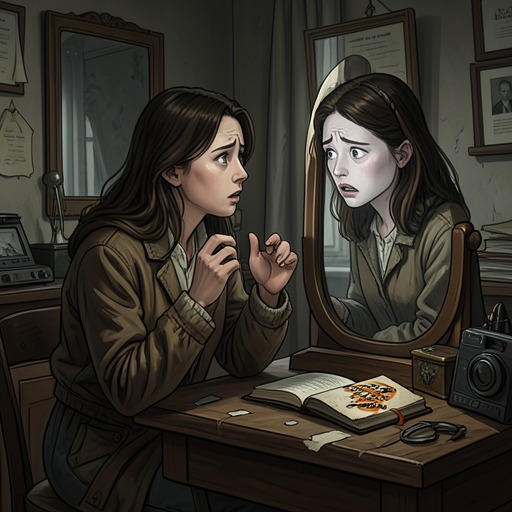
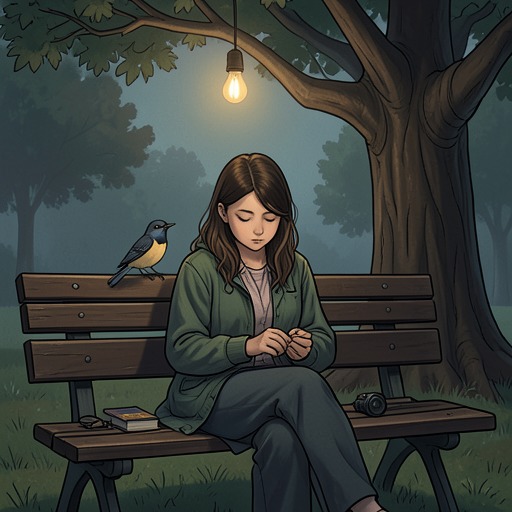
Turtles All the Way DownSelfhood, agency, and the story of a life names a central problem in Aza Holmes’s experience: whether a person is the author of a life or a character whose actions are shaped by forces beyond conscious choice. The novel places that question in ordinary settings—a school lunch period, a conversation with a friend, a therapy appointment—and in the body’s less governable processes. Its answer remains unsettled. Aza can describe the stories through which she understands herself, but she cannot simply choose what she thinks, feels, or does.
Authorship and the forces that shape a life
At White River High School, Aza first considers the possibility that she might be fictional. The thought arises during a precisely timed lunch period, from 12:37 to 1:14 P.M., which she must follow because of institutional forces she cannot identify. She imagines that a different lunch schedule, or a different conversation with her tablemates, might have produced a different ending—or at least a different middle. The idea that a life is a story told about someone, rather than a story that person tells, turns a mundane timetable into a challenge to personal authorship.
Aza’s account does not present choice as wholly unreal. Instead, it distinguishes the feeling of choosing from the conditions that make a choice possible. She may experience herself as deciding to go to lunch, but the bell has already determined when she must go. The image of a person who thinks they are painting, only to discover they are the canvas, gives this conflict a material form: the self that claims to act may also be the surface on which other forces leave their marks.
The cafeteria intensifies the thought. Hundreds of voices blur into a rushing sound, while fluorescent lights, Lysol, and the smell of lard make the room feel less like a stage for individual heroes than a crowded habitat of organisms. Aza’s sandwich and Dr Pepper bring the abstract question back to bodily life; even eating feels difficult to contemplate without becoming newly conscious of it. The scene links narrative agency to physical existence: a person imagines a private, authored epic while living among other bodies and processes that do not answer to intention.
The body, plurality, and recursive thought
Aza’s concern about who or what constitutes a person becomes concrete in her attention to the microbiome. As Mychal Turner describes an art project based on averaging the faces of a hundred people named Mychal, Daisy Ramirez proposes shifting it toward formerly imprisoned men who were exonerated, bringing race, class, and mass incarceration into the project. Aza hears the exchange while worrying about the microorganisms inside her. The contrast is sharp: her friends discuss how one person’s face might be made from many others, while she wonders whether the many cells and organisms within a body unsettle the idea of a singular self.
That question draws Aza into a recursive train of thought until she feels removed from the cafeteria and from ordinary sensation. The episode gives the concept a formal shape: thinking about the self does not necessarily clarify it, because each attempt to locate an observer inside the person becomes another thought that the observer must then account for. The self is not only the subject of reflection but also the source of further reflection, with no obvious point at which the loop ends.
Her finger makes this problem physical. Since childhood, Aza has pressed her thumbnail into the pad of her middle finger, leaving a callus that can crack open. She covers the skin with a Band-Aid, but fear of infection can lead her to reopen the wound and press at it. In the cafeteria she removes the Band-Aid and digs into the callused skin. The action is neither an expression of a considered wish nor an example of complete helplessness: she recognizes the compulsion and its danger, yet feels unable not to act. The body becomes both evidence of a self—something that can feel pain—and a site where deliberate control falters.
Intrusive thoughts and the limits of choice
The novel distinguishes an intrusive thought from a chosen intention without suggesting that the distinction makes the thought easy to dismiss. Aza understands that the infection fear is not something she wants to pursue. She has learned through cognitive behavioral therapy to remind herself that she is not identical to her thoughts, and she tries to mentally close the thought away. But the concern returns with a new possibility: perhaps the wound contacted contaminated water. The imagined risk gains force from its qualifications and uncertainties, until she goes to the bathroom and checks the Band-Aid for moisture.
This pattern complicates the comforting idea that a person can choose one thought over another. Aza questions William James’s account of thought as selectable, experiencing thoughts instead as something closer to destiny than a catalogue she can freely browse. When she was young, her mother advised her not to think about distressing things; Aza’s experience makes clear why advice of that kind cannot itself create control. Davis Pickett understands the difficulty: the problem, as Aza sees it, is precisely that thoughts cannot always be chosen.
The distinction matters to her sense of identity. If an unwanted thought arises inside a person, its presence does not establish that the person endorses it; yet if the person cannot silence or redirect it, the boundary between self and thought becomes difficult to explain. Aza’s recurring effort to separate herself from an invasive thought therefore has an unstable result. It may offer a momentary distance, but the returning thought can immediately make that distance feel insufficient.
Relationships as ways of thinking about the self
Aza’s conversations with Davis turn these private questions into shared inquiry. Their exchange about money and identity develops into a question about what anyone is. Aza calls the word I difficult to define, and Davis suggests that a person might be what they cannot help being. Their exchange does not settle whether identity is chosen or imposed. Instead, it puts the two possibilities beside each other: there may be something persistent in a person, but persistence need not mean that the person has authored it.
Aza also remembers being eleven and sitting beside Davis at camp, their legs hanging over the edge of a dock as they looked at the same cloudless sky. They had not needed to talk much or look directly at one another for the shared view to feel intimate. That memory offers a relational counterpoint to the isolated work of trying to define the self. Another person cannot answer the question of who Aza is for her, but being understood—or finding someone who sees the same world—can make the question less solitary.
In therapy, Aza asks how a person can be something to their own self without implying that the self is singular. Dr. Karen Singh does not reduce the question to a simple definition. She proposes that a self may be plural and still integrated, comparing it to a rainbow that is one arc of light and also several differently colored arcs. Aza says that she feels more like seven things than one. The image preserves multiplicity rather than treating it as proof that there is no coherent person at all.
Medication raises a related problem for Aza. She worries that taking a pill might change who she is, as though the meaning of the self were decided either by her or by the people making Lexapro. She describes her distress through the image of a demon she wants gone, while also finding the idea of removing it by medication strange. Some days she takes the pill because she hates the demon; on others, fear makes her hesitate. The conflict is not simply between a true self and an external treatment. It is about how to recognize oneself when changes in thought and feeling can seem to threaten the identity one is trying to protect.
The parasite and the story of a life
When Aza explains her fear to Davis, she describes a parasite whose life cycle depends on changing a fish’s behavior. The parasite matures in a fish’s eyes but must reproduce in a bird’s stomach. Infected fish swim deep while the parasite is immature; when it is ready to reproduce, they move toward the surface, where birds can eat them. The parasite’s cycle continues through the bird and back into the water. For Aza, the disturbing possibility is that the fish’s apparent actions serve a story authored by something inside it.
The analogy makes her question of agency vivid without resolving it. Aza fears that she, too, may experience a life as her own while being directed by processes she cannot perceive. The image connects her earlier worries about microorganisms to the more intimate problem of whether a thought, impulse, or bodily response belongs to the person experiencing it. It also exposes the limits of self-knowledge: feeling that an action is one’s own cannot, by itself, prove that no hidden influence has shaped it.
Aza tells Davis that pressing her thumbnail into her finger began as a way of reassuring herself that she was real. Her mother had taught her that pain could show she was not dreaming, and the sensation briefly seemed to confirm her existence. But the fish can feel pain too. Pain establishes that an experience is happening; it cannot establish who, or what, is authoring the larger story. In this image, the novel brings its central idea to an unresolved edge: embodied experience makes the self tangible, while neither thought nor sensation provides a final proof of complete control.